
Strength Training for Beginners – Complete Science-Based Guide (2025)


Learn strength training for beginners with this complete science-based guide. Discover proven exercises, proper form, and workout plans backed by real research.
Introduction
Here’s something amazing, research shows (5) that beginners can see muscle growth start happening in just 6-10 weeks of consistent strength training. That’s pretty incredible, right! So, if you’re feeling intimidated by the weight room or confused about where to start your strength training journey, you’re definitely not alone. I especially remember, going into the gym for the first time at age eighteen, staring at dumbbells and barbells wondering if I’m going to embarrass myself or worse, get injured. So yeah, I get it.
Here’s the thing, strength training isn’t just about getting “swole” or looking like a bodybuilder. It’s about building a stronger, more resilient body that serves you better in everyday life. So, whether you want to carry groceries without strain, play with your kids without getting winded, or simply feel more confident in your own skin, this complete guide will give you everything you need to start your strength training journey safely and effectively. At the same time, we’ll cut through the fitness industry BS and focus on what science actually tells us works!
Quick Fact: According to a comprehensive review published in the Journal of Sports Science Medicine (6), resistance training can increase bone density by 1-3% and significantly reduce fracture risk.
What Is Strength Training and Why Should You Care?
Definition and Fundamentals
Strength training, also known as resistance training, involves exercises that make your muscles work against a weight or force. This could be:
- Your own body weight (push-ups, squats)
- Free weights (dumbbells, barbells)
- Resistance bands
- Weight machines
- Household items (water jugs, backpacks)
Science-Backed Benefits
Research consistently shows that strength training delivers incredible benefits across multiple areas of health:
Physical Benefits:
- Increased bone density – A Harvard Health study (6) found that strength training can play a role in slowing bone loss, and can even build bone, which is tremendously useful to help offset age-related declines in bone mass
- Boosted muscle mass – A systematic review (5) showed that resistance training leads to significant muscle hypertrophy gains, with the most dramatic changes occurring within 6-10 weeks
- Enhanced functional strength – Makes daily activities easier and reduces injury risk
- Improved metabolic health – Research published in Sports Medicine (8) shows that resistance training consistently improved muscle mass, strength and physical function compared to no exercise
Mental Benefits:
- Reduced depression and anxiety – A major meta-analysis (4) of 33 studies found that people with mild to moderate depression who performed resistance training two or more days a week saw “significant” reductions in their symptoms
- Increased confidence – Both in and out of the gym
- Better sleep quality – Research (3) confirms that regular and adequate sleep helps repair and restore muscles, and strength training can improve sleep quality
- Enhanced mood – Penn Medicine research (9) shows strong evidence that weight training can help prevent and treat depression
Common Myths Debunked
Myth: “Lifting makes women bulky” Reality: Women lack the testosterone to build massive muscle. Strength training creates a lean, toned physique.
Myth: “Cardio is better for weight loss” Reality: Research published in the Journal of Sports Medicine (2) shows that resistance training enhances muscle hypertrophy and provides metabolic benefits beyond just the workout period
Myth: “You need expensive equipment” Reality: Bodyweight exercises and basic equipment can provide incredible results.
How Strength Training Differs from Cardio
| Strength Training | Cardio |
|---|---|
| Builds muscle mass | Primarily burns calories during exercise |
| Increases metabolism long-term | Limited post-exercise calorie burn |
| Improves bone density | Improves cardiovascular endurance |
| Progressive overload focus | Time/distance focus |
Essential Equipment for Beginner Strength Training
Home Workout Must-Haves
Adjustable Dumbbells
- Space-efficient and versatile
- Cost: $100-300 for quality set
Resistance Bands
- Perfect for travel and small spaces
- Provide variable resistance
- Cost: $15-50 for complete set
Yoga Mat
- Essential for floor exercises
- Provides cushioning and grip
- Cost: $20-60 for quality mat
Gym Equipment Overview
Free Weights Section:
- Dumbbells (start light, focus on form)
- Barbells (empty bar weighs 45 lbs)
- Kettlebells (great for compound movements)
Machine Section:
- Cable machines (adjustable resistance)
- Leg press (safer than squats initially)
- Lat pulldown (builds to pull-ups)
Budget-Friendly Alternatives
| Expensive Equipment | Budget Alternative | Cost Savings |
|---|---|---|
| Gym membership ($50/month) | Bodyweight + bands | $600/year |
| Full dumbbell set ($500) | Adjustable dumbbells ($200) | $300 |
| Cable machine ($800) | Resistance bands ($30) | $770 |
Safety Equipment Recommendations
Proper Athletic Shoes
- Cross-trainers for general lifting
- Flat soles for deadlifts/squats
Especially When You DO Need Equipment:
- Lifting belt for heavy squats/deadlifts (6+ months in)
- Wrist wraps for heavy pressing (optional)
- Knee sleeves for joint support (if needed)
Safety First: Never compromise on proper footwear. Poor shoes can lead to injury and poor form.
Mastering Proper Form – Your Foundation for Success
Why Form Trumps Weight Every Time
Most important, here’s what happens when you prioritize weight over form:
- Increased injury risk – Poor form stresses joints incorrectly
- Reduced effectiveness – Wrong muscles do the work
- Bad habits – Harder to unlearn than learn correctly
- Plateau faster – Compensation patterns limit progress
Fundamental Movement Patterns
The Big 6 Movement Patterns:
- Squat (Hip and knee flexion)
- Hinge (Hip flexion, knee stable)
- Push (Horizontal and vertical)
- Pull (Horizontal and vertical)
- Lunge (Single-leg patterns)
- Carry (Core stability)
Common Form Mistakes
| Exercise | Common Mistake | Fix |
|---|---|---|
| Squat | Knees cave inward | Push knees out over toes |
| Deadlift | Rounded back | Keep chest up, shoulders back |
| Push-up | Sagging hips | Engage core, straight line |
| Row | Using momentum | Slow, controlled movement |
Self-Assessment Strategies
Mirror Method:
- Position yourself sideways to mirror
- Perform movement slowly
- Check alignment at each phase
Video Analysis:
- Record from side view
- Compare to proper form videos
- Look for one thing to improve at a time
Body Awareness Cues:
- Feel which muscles are working
- Notice points of tension
- Start with bodyweight versions
Pro Tip: Use your phone’s slow-motion video feature to analyze your form. Many form issues are only visible when slowed down.
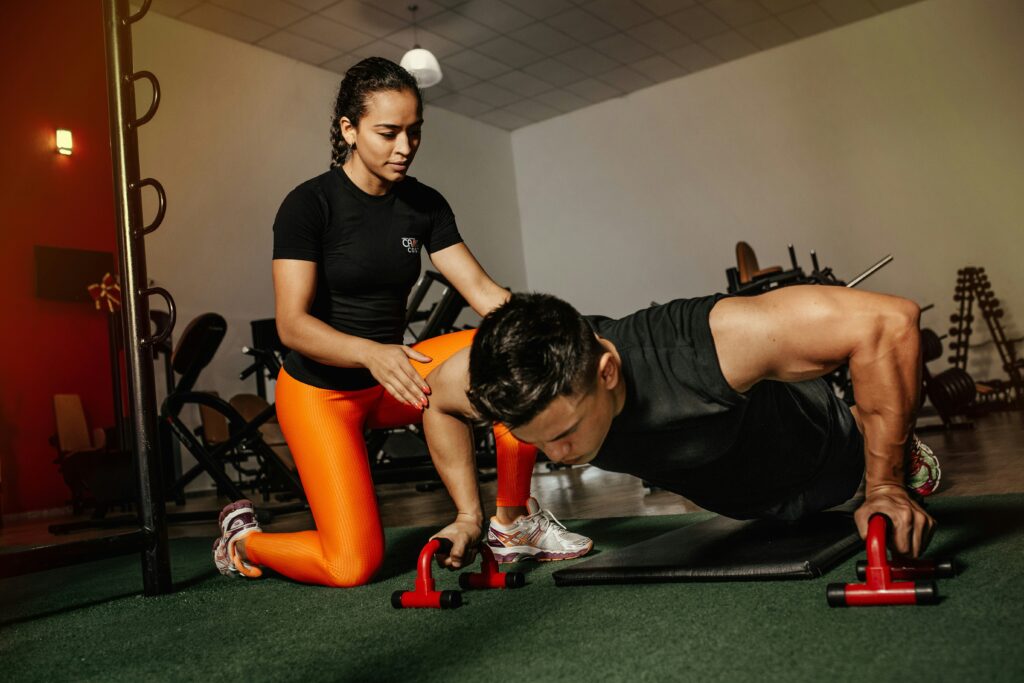
Finally, When to Ask for Help
Certainly, Seek Professional Guidance If:
- You’re unsure about any movement
- You have previous injuries
- You’re not feeling exercises in the right muscles
- You want to learn complex movements (deadlifts, squats)
The Science Behind Progressive Overload
Specifically, What Does Progressive Overload Actually Mean?
Progressive overload is the gradual increase in stress placed on your muscles during exercise. Think of it as giving your muscles a slightly harder challenge each week so they’re forced to adapt and grow stronger.
The principle works because:
- Muscles adapt to current demands
- Adaptation requires increased stimulus
- Consistent progression prevents plateaus
- Small changes create big results over time
Research-Backed Methods to Progress
Research by Schoenfeld and colleagues (7) found that 10 weekly sets per muscle group or more may be necessary to maximize muscle hypertrophy, with strength training promoting better results with higher doses.
First Method : Increase Weight
- Add 2.5-5 lbs when you can complete all sets/reps
- Most straightforward progression method
- Example: Bench press 100 lbs → 105 lbs
Second Method: Increase Reps
- Add 1-2 reps per set when possible
- Great for bodyweight exercises
- Example: 8 push-ups → 10 push-ups
Third Method: Increase Sets
- Add an extra set to exercises
- Increases total training volume
- Example: 3 sets → 4 sets
Fourth Method: Decrease Rest Time
- Reduces rest between sets by 15-30 seconds
- Increases training density
- Builds muscular endurance
Tracking Your Progress Effectively
Simple Log Method:
- Week 1: 3 sets x 8 reps @ 65 lbs
- Week 2: 3 sets x 10 reps @ 65 lbs
- Week 3: 3 sets x 8 reps @ 70 lbs
Progressive Rep Scheme:
- Week 1: 3 x 8-10 reps
- Week 2: 3 x 10-12 reps
- Week 3: 3 x 12-15 reps
- Week 4: Increase weight, back to 3 x 8-10
Understanding Intensity, Volume, and Frequency
| Term | Definition | Beginner Recommendation |
|---|---|---|
| Intensity | How heavy the weight | 60-70% of maximum effort |
| Volume | Total sets x reps | 10-16 sets per muscle per week |
| Frequency | How often you train | 2-3 times per week |
Avoiding the Plateau Trap
Plateau Prevention Strategies:
- Vary your exercises every 4-6 weeks
- Alternate between strength (3-6 reps) and hypertrophy (8-12 reps) phases
- Include deload weeks (reduce intensity by 40-50%)
- Focus on different aspects (strength, endurance, power)
Research Note: New studies (8) show that muscle hypertrophy that occurs at initial stages of resistance training (~4 sessions) is mostly attributable to muscle damage induced cell swelling, with the majority of strength gains resulting from neural adaptations (8−12 sessions)
Best Strength Training Exercises for Beginners
The “Big 6” Fundamental Movements
[IMAGE SUGGESTION: Exercise demonstration grid showing proper form for each of the Big 6]
1. Squat Pattern
Bodyweight Squat
- Targets: Quads, glutes, hamstrings, core
- Progression: Air squat → Goblet squat → Front squat
- Common mistakes: Knees caving, not going deep enough
How to perform:
- Feet shoulder-width apart, toes slightly out
- Initiate by pushing hips back
- Lower until thighs parallel to floor
- Drive through heels to stand
2. Hip Hinge Pattern
Romanian Deadlift (Bodyweight/Dumbbell)
- Targets: Hamstrings, glutes, lower back
- Progression: Bodyweight RDL → Dumbbell RDL → Barbell deadlift
- Common mistakes: Rounding back, knee bend
3. Vertical Push
Push-up Progression
- Targets: Chest, shoulders, triceps, core
- Progression: Wall push-up → Incline → Knee → Full → Decline
- Common mistakes: Sagging hips, partial range of motion
4. Vertical Pull
Assisted Pull-up/Lat Pulldown
- Targets: Lats, rhomboids, rear delts, biceps
- Progression: Band-assisted → Negative reps → Full pull-up
- Common mistakes: Using momentum, not full range
5. Horizontal Push
Dumbbell Press
- Targets: Chest, front delts, triceps
- Progression: Floor press → Incline → Flat bench
- Common mistakes: Arching back excessively, pressing too fast
6. Horizontal Pull
Bent-over Row
- Targets: Mid-traps, rhomboids, rear delts, biceps
- Progression: Single-arm → Bent-over → Barbell row
- Common mistakes: Standing too upright, using momentum
Bodyweight Progressions
| Exercise | Beginner | Intermediate | Advanced |
|---|---|---|---|
| Push-up | Wall push-up | Knee push-up | Full push-up |
| Squat | Chair-assisted | Bodyweight | Jump squat |
| Pull-up | Band-assisted | Negative | Full pull-up |
| Plank | 15 seconds | 60 seconds | 2+ minutes |
Dumbbell Exercises for Major Muscle Groups
Upper Body:
- Dumbbell bench press (chest)
- Bent-over row (back)
- Overhead press (shoulders)
- Bicep curls (biceps)
- Tricep extensions (triceps)
Lower Body:
- Goblet squats (quads/glutes)
- Romanian deadlifts (hamstrings/glutes)
- Walking lunges (legs/glutes)
- Calf raises (calves)
Core:
- Russian twists with dumbbell
- Weighted planks
- Wood chops
Machine Alternatives for Nervous Beginners
Why machines can be helpful:
- Fixed movement path (safer)
- Easier to learn
- Quick weight adjustments
- Built-in safety features
Best beginner-friendly machines:
- Leg press (instead of squats)
- Lat pulldown (builds to pull-ups)
- Chest press (instead of bench press)
- Seated row (easier than bent-over)
- Leg curl/extension (isolated leg work)
Modification Strategies
Limited Mobility:
- Chair-based exercises
- Resistance band alternatives
- Partial range of motion
- Supported movements
Joint Issues:
- Low-impact alternatives
- Reduced range of motion
- Focus on form over intensity
- Consult healthcare provider
Time Constraints:
- Compound movements only
- Circuit-style training
- Superset exercises
- 20-minute focused sessions
Creating Your First Strength Training Program
Full-Body vs. Split Routines: What Works Best for Beginners
Full-Body Routine (Recommended for Beginners)
Pros:
- Train each muscle 2-3x per week
- More flexible scheduling
- Better for building habits
- Higher calorie burn per session
Cons:
- Longer individual sessions
- May feel rushed initially
Split Routine (Better for Intermediate+)
Pros:
- Focus on specific muscle groups
- Shorter individual sessions
- More exercises per muscle
Cons:
- Each muscle trained only 1x per week
- Less flexible scheduling
- Requires more gym days
Training Frequency – Less Is Often More
Research-backed recommendations:
A study published in the Journal of Strength and Conditioning Research (8) found that both high frequency training (three sets on three occasions per week) and low frequency training (nine sets, on one occasion per week) produced similar improvements in lean mass and strength in resistance-trained individuals
| Experience Level | Frequency | Rest Days |
|---|---|---|
| Complete beginner | 2 days/week | 2-3 days between sessions |
| Beginner (1-3 months) | 3 days/week | 1 day between sessions |
| Intermediate (3-12 months) | 3-4 days/week | 1-2 days between sessions |
Why beginners need more rest:
- Nervous system adaptation takes time
- Higher risk of overuse injuries
- Form improvement happens during rest
- Motivation stays higher with achievable goals
Sample Beginner Workout Templates
Template 1: 2-Day Full Body Split
Day 1: Monday
- Bodyweight Squats: 3 sets x 8-12 reps
- Push-ups (modified if needed): 3 sets x 5-10 reps
- Bent-over Dumbbell Row: 3 sets x 8-12 reps
- Plank: 3 sets x 15-30 seconds
- Walking in place: 5 minutes
Day 2: Thursday
- Goblet Squats: 3 sets x 8-12 reps
- Dumbbell Chest Press: 3 sets x 8-12 reps
- Lat Pulldown (or assisted pull-up): 3 sets x 6-10 reps
- Romanian Deadlift: 3 sets x 8-12 reps
- Side Plank: 2 sets x 10-20 seconds each side
Template 2: 3-Day Full Body Split
Monday – Push Focus
- Goblet Squats: 3 x 10
- Push-ups: 3 x 8
- Overhead Press: 3 x 10
- Tricep Dips: 2 x 8
- Plank: 3 x 30 seconds
Wednesday – Pull Focus
- Romanian Deadlift: 3 x 10
- Bent-over Row: 3 x 10
- Lat Pulldown: 3 x 8
- Bicep Curls: 2 x 12
- Dead Bug: 3 x 8 each side
Friday – Legs Focus
- Bodyweight Squats: 3 x 12
- Walking Lunges: 3 x 8 each leg
- Glute Bridges: 3 x 12
- Calf Raises: 3 x 15
- Wall Sit: 3 x 20-30 seconds

Rest Day Importance and Active Recovery
What happens during rest:
- Muscle protein synthesis (growth)
- Nervous system recovery
- Energy store replenishment
- Adaptation and strengthening
Active Recovery Options:
- 20-30 minute walks
- Gentle yoga or stretching
- Light swimming
- Recreational activities (gardening, playing with kids)
- Foam rolling or self-massage
Program Progression Guidelines
Form Foundation: Week 1-2
- Focus entirely on proper form
- Use lighter weights or bodyweight
- Don’t worry about intensity
Add Intensity: Week 3-4
- Increase weight by 2.5-5 lbs when you can complete all reps
- Add 1-2 reps to bodyweight exercises
- Start tracking your workouts
Build Consistency: Week 5-8
- Establish your routine
- Focus on progressive overload
- Add variety to prevent boredom
Assess and Adjust: Week 9-12
- Evaluate your progress
- Consider adding complexity
- Plan your next program phase
Pro Tip: Print your workout template and check off each set. There’s something satisfying about physical progress tracking that apps can’t replicate!
Nutrition and Recovery for Strength Training Success
Protein Requirements – Cutting Through the Hype
What the research actually shows:
A comprehensive meta-analysis published in Sports Medicine(8) found a clear dose-response relationship between protein supplementation and muscle strength, with benefits seen both with and without resistance training
| Goal | Protein per lb bodyweight | Example (150 lb person) |
|---|---|---|
| General health | 0.4-0.5g | 60-75g daily |
| Muscle building | 0.7-1.0g | 105-150g daily |
| Fat loss + muscle preservation | 0.8-1.2g | 120-180g daily |
High-quality protein sources:
- Animal: Chicken, fish, eggs, dairy, lean beef
- Plant: Legumes, quinoa, tofu, tempeh, protein powder
- Complete proteins contain all essential amino acids
Pre and Post-Workout Nutrition: Myths vs. Reality
Pre-Workout Nutrition
Myth: “You must eat 30 minutes before working out” Reality: Train when you feel best. Some prefer fasted, others need fuel.
If you choose to eat before:
- 1-3 hours before: Full meal with carbs and protein
- 30-60 minutes before: Light snack (banana, toast)
- Avoid: High fat, high fiber foods that may cause discomfort
Post-Workout Nutrition
Myth: “You have a 30-minute anabolic window” Reality: Total daily protein matters more than timing.
Post-workout guidelines:
- Eat within 2-3 hours (not necessarily immediately)
- Include protein (20-40g) and carbohydrates
- Focus on whole foods when possible
- Hydrate adequately
Sleep – The Underestimated Recovery Tool
Why sleep matters for strength training:
Research published in Medical Hypotheses(3) found that sleep debt decreases the activity of protein synthesis pathways and increases the activity of degradation pathways, favoring the loss of muscle mass and thus hindering muscle recovery after exercise
| Hours of Sleep | Impact on Performance |
|---|---|
| Less than 6 | Significant impairment in recovery |
| 6-7 hours | Suboptimal recovery |
| 7-9 hours | Optimal for most people |
| More than 9 | Diminishing returns |
Sleep optimization strategies:
- Consistent bedtime and wake time
- Cool, dark room (65-68°F)
- No screens 1 hour before bed
- Avoid caffeine 6+ hours before sleep
- Consider magnesium supplementation
A study published in Medicine & Science in Sports & Exercise(7) found that total sleep deprivation after muscle damage does not delay muscle strength recovery but modifies inflammatory and hormonal responses.
Hydration Guidelines for Optimal Performance
Daily baseline: Half your body weight in ounces
- 150 lb person = 75 oz (about 9 cups) daily
During exercise: Add 16-24 oz per hour of training
Signs of proper hydration:
- Light yellow urine
- Consistent energy levels
- No excessive thirst
Supplement Science – What Works vs. Marketing
Evidence-Based Supplements
Creatine Monohydrate
- Benefit: 5-15% strength increase
- Dose: 3-5g daily
- Cost: $10-20 for 3-month supply
Protein Powder (if dietary protein is low)
- Benefit: Convenient protein source
- Dose: 20-40g per serving
- Cost: $30-60 for month supply
Vitamin D (if deficient)
- Benefit: Bone health, immune function
- Dose: 1000-2000 IU daily
- Cost: $10-15 for 6-month supply
Overhyped Supplements
Pre-workout complex formulas
- Often just caffeine + marketing
- Save money: drink coffee
BCAAs (if eating adequate protein)
- Unnecessary with complete protein intake
- Expensive amino acid water
Fat burners
- No magic pills for fat loss
- Focus on calorie deficit instead
Testosterone boosters
- No evidence in healthy individuals
- Save money for real food
Hydration and Recovery Checklist
Daily Recovery Checklist:
- [ ] 7-9 hours of quality sleep
- [ ] Adequate protein intake (0.7-1g per lb)
- [ ] Proper hydration throughout day
- [ ] Light movement on rest days
- [ ] Manage stress levels
- [ ] Listen to your body for fatigue signals
Research Insight: A narrative review published in Sports Medicine found that sleep extension improved performance, pain sensitivity and growth hormone/IGF-I anabolic responses, which may be beneficial in accelerating recovery from muscle injuries
Avoiding Common Beginner Mistakes
The “More Is Better” Mentality
Why it backfires:
- Overtraining leads to injury and burnout
- Quality beats quantity every time
- Recovery is when adaptation happens
- Consistency trumps intensity for beginners
Signs you’re doing too much:
- Constant muscle soreness
- Declining performance
- Dreading workouts
- Frequent minor injuries
- Irritability and poor sleep
The fix:
- Start with 2-3 sessions per week
- Focus on form over intensity
- Plan rest days into your schedule
- Listen to your body’s signals
Ego Lifting – Check Your Pride at the Door
What ego lifting looks like:
- Using weights too heavy for proper form
- Comparing yourself to others in the gym
- Skipping warm-ups to “save time for real lifting”
- Avoiding “easier” exercises that would benefit you
The reality check:
- The strongest people in the gym started with light weights
- Perfect form with 10 lbs is better than poor form with 50 lbs
- Everyone is focused on their own workout, not judging you
- Consistency beats intensity for long-term results
Ego-crushing truths:
- You’ll lift heavier next month than this month
- Form breaks down = injury risk skyrockets
- Light weights built every strong person you admire
- Your future self will thank you for patience
Common inconsistency triggers:
- All-or-nothing thinking (“I missed Monday, so this week is ruined”)
- Unrealistic goals (7 days/week when you’re busy)
- Lack of planning (no set workout times)
- Perfectionism (skipping workouts if you can’t do the “full” routine)
Inconsistency Patterns and Habit Building
Building lasting habits:
Show up: Week 1-2
- Don’t worry about perfect workouts
- Just get to the gym or workout space
- Even 10 minutes counts
Build routine: Week 3-4
- Same days, same times
- Prepare gym clothes the night before
- Stack the habit (after coffee, before shower)
Find your rhythm: Week 5-8
- Adjust schedule based on what’s working
- Allow flexibility while maintaining consistency
- Celebrate small wins
Unrealistic Expectations vs. Reality
Unrealistic timeline expectations:
| Timeframe | Unrealistic Expectation | Reality |
|---|---|---|
| 1 week | “I should see muscle growth” | Body learning movement patterns |
| 1 month | “I should look totally different” | Small strength gains, improved energy |
| 3 months | “I should be lifting heavy” | Solid form, consistent routine established |
| 6 months | “I should look like a fitness model” | Noticeable strength and physique changes |
Realistic beginner milestones:
First Month:
- Completing workouts without excessive soreness
- Learning proper form for basic exercises
- Establishing consistent routine
Month 2-3:
- Noticeable strength increases
- Better sleep and energy
- Clothes fitting differently
Month 4-6:
- Visible muscle definition
- Significant strength gains
- Exercise feels natural, not forced
Social Media Fitness – Influence vs. Science
Red flags in fitness content:
- 30-day transformation promises
- “Secret” exercises that trainers don’t want you to know
- Before/after photos with different lighting/posing
- Extreme diets or workout protocols
- Supplements as the “magic solution”
What to look for instead:
- Credentials (CSCS, NASM, ACSM)
- Citations to research studies
- Realistic timelines and expectations
- Emphasis on consistency over intensity
- Acknowledgment of individual differences
Curating your social feed:
Tracking Progress Beyond the Scale
- Follow evidence-based fitness professionals
- Unfollow accounts that make you feel inadequate
- Seek diverse body types and abilities
- Focus on performance goals, not just aesthetics
Social Media Reality Check: Those “12-week transformations” often involve professional lighting, posing coaching, extreme temporary measures, and sometimes even different people. Focus on your own journey!
Why the Scale Lies (And What to Measure Instead)
Problems with scale-only tracking:
- Water weight fluctuations (2-5 lbs daily)
- Muscle weighs more than fat
- Hormonal changes affect weight
- Doesn’t reflect body composition changes
- Can be demotivating and misleading
What the scale CAN tell you:
- Long-term trends (not daily fluctuations)
- Whether you’re in a calorie deficit/surplus
- Progress when combined with other metrics
Strength Benchmarks That Actually Matter
Bodyweight Strength Goals:
| Exercise | Beginner Goal | Intermediate Goal |
|---|---|---|
| Push-ups | 10 consecutive | 25 consecutive |
| Squats | 20 consecutive | 50 consecutive |
| Plank | 60 seconds | 2+ minutes |
| Wall Sit | 60 seconds | 2+ minutes |
Weight Training Milestones:
Note: These are general guidelines. Your goals should be personal and relative to your starting point.
For a 150 lb person:
- Goblet Squat: 25 lbs → 50 lbs
- Dumbbell Row: 15 lbs → 35 lbs
- Push-ups: Wall → Knee → Full
- Deadlift: Bodyweight → 1.5x bodyweight (advanced)
Performance Metrics Beyond Numbers
Functional improvements:
- Carrying groceries without strain
- Playing with kids without getting winded
- Taking stairs without breathlessness
- Better posture throughout the day
- Improved balance and coordination
Energy and mood metrics:
- Sleep quality improvements
- Energy levels throughout the day
- Mood stability and confidence
- Stress management ability
- Overall life satisfaction
Photo Documentation Strategy
Best practices for progress photos:
- Same time of day (morning is ideal)
- Consistent lighting (natural light preferred)
- Same poses (front, side, back)
- Same clothing (or similar)
- Monthly frequency (not daily/weekly)
- Focus on posture and muscle definition, not just weight loss
Photo poses that show progress:
- Front: Arms at sides, relaxed posture
- Side: Arms at sides, natural stance
- Back: Arms at sides, showing posterior development
Body Measurement Tracking
Key measurements to track:
| Measurement | How to Measure | Frequency |
|---|---|---|
| Waist | Narrowest point, relaxed | Bi-weekly |
| Hips | Widest point of hips | Bi-weekly |
| Chest | Around fullest part | Monthly |
| Arms | Largest part of bicep, flexed | Monthly |
| Thighs | Largest part, standing | Monthly |
Measurement tips:
- Same time of day (morning preferred)
- Consistent tension on tape measure
- Stand naturally, don’t suck in
- Record everything, even if numbers seem “bad”
Celebrating Non-Scale Victories
Physical victories:
- First full push-up
- Lifting a weight that felt impossible before
- Completing a workout without modification
- Improved flexibility and mobility
- Better recovery between sets
Mental victories:
- Looking forward to workouts
- Feeling confident in the gym
- Choosing stairs over elevators
- Better stress management
- Improved body image and self-confidence
Lifestyle victories:
- Consistent sleep schedule
- Healthier food choices
- Increased daily activity
- Better mood regulation
- Inspiring others to start their fitness journey
Using Technology Effectively
Recommended tracking apps:
- Workout logging: Strong, Jefit, pen and paper
- Progress photos: Built-in phone camera with albums
- Measurements: MyFitnessPal, Cronometer
- Overall progress: Spreadsheet or fitness journal
What to avoid:
- Obsessive daily weigh-ins
- Comparing your progress to social media
- Tracking too many metrics at once
- Perfectionism in data collection
Tracking Tip: Choose 2-3 metrics that matter most to you and track consistently. Better to have good data on a few things than poor data on everything.
Your Next Steps to Strength Training Success
Starting your strength training journey doesn’t have to be overwhelming or intimidating! Remember, every expert was once a beginner who felt just as confused as you might feel right now. The key is starting with proper form, being consistent with your efforts, and trusting the process.
You now have the science-backed foundation to begin building strength safely and effectively. Don’t try to do everything at once – pick a few basic exercises, master the movements, and gradually progress from there. Your future self will thank you for taking this first step toward a stronger, healthier life.
Your Action Plan This Week
First Step: Choose Your Starting Point
- [ ] Decide between home or gym workouts
- [ ] Select one of the beginner programs from this guide
- [ ] Schedule your workout days in your calendar
Second Step: Gather Your Tools
- [ ] Get basic equipment (dumbbells, resistance bands, or gym membership)
- [ ] Download a workout tracking app or prepare a notebook
- [ ] Take your baseline measurements and photos
Third Step: Start Small and Build
- [ ] Complete one workout this week focusing entirely on form
- [ ] Plan your rest days and active recovery
- [ ] Connect with supportive friends or online communities
Ready to Take Action?
Choose one bodyweight exercise from this guide and commit to doing it three times this week. That’s it! Small actions lead to big transformations, and your strength training journey begins with that very first rep.
Share Your Success
Starting a strength training routine is a big step – you should be proud! Share this guide with someone who might benefit from it, and let us know about your first workout experience in the comments below.
Remember: Every rep counts, every workout matters, and every day you choose strength over convenience, you’re building the person you want to become.
Ready to start your transformation? Your strongest self is waiting.
Was this guide helpful? Save it for later and share it with someone who needs to see it!
References
- Ashton, R. E., et al. (2020). Effects of short-term, medium-term and long-term resistance exercise training on cardiometabolic health outcomes in adults: systematic review with meta-analysis. British Journal of Sports Medicine, 54(6), 341-348.
- Cunha, P. M., et al. (2022). Can resistance training improve mental health outcomes in older adults? A systematic review and meta-analysis of randomized controlled trials. Psychiatry Research, 333, 115728.
- Dattilo, M., et al. (2011). Sleep and muscle recovery: endocrinological and molecular basis for a new and promising hypothesis. Medical Hypotheses, 77(2), 220-222.
- Gordon, B. R., et al. (2018). Association of efficacy of resistance exercise training with depressive symptoms: meta-analysis and meta-regression analysis of randomized clinical trials. JAMA Psychiatry, 75(6), 566-576.
- Krzysztofik, M., et al. (2019). Maximizing muscle hypertrophy: a systematic review of advanced resistance training techniques and methods. International Journal of Environmental Research and Public Health, 16(24), 4897.
- Layne, J. E., & Nelson, M. E. (1999). The effects of progressive resistance training on bone density: a review. Medicine & Science in Sports & Exercise, 31(1), 25-30.
- Reiss, J., et al. (2017). Effects of sleep deprivation on acute skeletal muscle recovery after exercise. Medicine & Science in Sports & Exercise, 51(3), 507-514.
- Schoenfeld, B. J., et al. (2017). Dose-response relationship between weekly resistance training volume and increases in muscle mass: a systematic review and meta-analysis. Journal of Sports Sciences, 35(11), 1073-1082.
- Tsutsumi, T., et al. (1997). Comparison of high and moderate intensity of strength training on mood and anxiety in older adults. Perceptual and Motor Skills, 87(3), 1003-1011.
